


Legal Education & Insights
At Legal Insights, we provide property law–related guidance designed to empower individuals, tenants, landlords, and real estate professionals with clear, practical legal knowledge. Our platform helps you navigate the complexities of real estate laws in the UAE through trusted resources and expert collaborations.
The United Arab Emirates (UAE) has a well-defined legal framework to govern your property ownerships and rental transactions. The government has made robust laws to balance the rights of landlords, tenants, investors, and developers due to the rapidly growing real estate market especially in Dubai and Abu Dhabi.
The UAE Property Legal Framework
The UAE's property laws are structured through federal laws and local emirate-specific regulations. So, it basically operates through a dual-layered structure:
- Federal laws are applicable across all seven emirates (Abu Dhabi, Dubai, Sharjah, Ajman, Fujairah, Ras Al Khaimah, and Umm Al Quwain)
Local emirate-specific laws and authorities regulate the implementation and enforcement within each emirate.
1. Federal Property Legislation
The United Arab Emirates (UAE) has established a robust legal framework to regulate property ownership, development, and transactions through a combination of federal legislation and local emirate-level regulations. These laws ensure transparency, protect the rights of investors and owners, and support the sustainable growth of the UAE’s real estate market.
- Federal Law No. 5 of 1985 (Civil Transactions Law): It covers all general contractual and lease obligations.
- Federal Law No. 6 of 2018 on Arbitration: It governs all the dispute resolution mechanisms.
- UAE Civil Procedure Code: it is there to address execution and enforcement of property-related court decisions.
If you need more details, you can get them at the UAE Official Legal Portal.
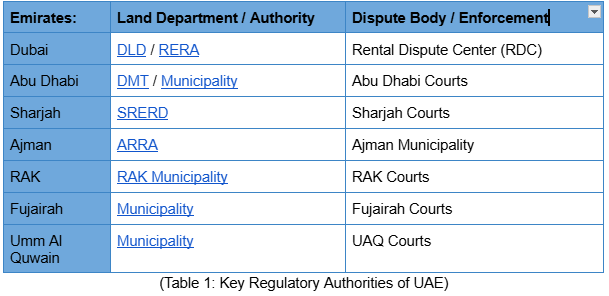
2. Emirate-Level Authorities and Laws
While federal law sets the overall legal foundation, each emirate has authority to regulate specific aspects of property ownership and registration within its jurisdiction.

Why Legal Awareness Matters?
Understanding your legal rights and position is very important, if you are a:
- Tenant seeking protection,
- A landlord setting rental terms, or
- An investor acquiring property.
Navigating the UAE property landscape without a solid understanding of your legal position can lead to costly mistakes or missed opportunities.
Legal Insights is here to help you make informed, confident decisions by providing practical legal guidance tailored to your real estate needs.
Tenancy Law & Eviction Procedures in UAE
Tenancy laws in UAE are governed at both federal and emirate levels. The basic lease principles are covered under the UAE Civil Transactions Law (Federal Law No. 5 of 1985). While each emirate has the authority to create and enforce its own rental laws, contracts, and dispute procedures.
The Federal law provides broad protections for tenants and landlords. It includes fair contracting, notice requirements, and rights during lease termination.
Who UAE Tenancy Laws Apply To?
- All UAE nationals and expatriates.
- Residential, commercial, and industrial leases.
It excludes hotels, vacation rentals, and tourism-managed properties.
Key Principles of Tenancy Contracts (Across UAE):
- A written lease agreement is mandatory (and should ideally be registered with the relevant authority (e.g., Ejari in Dubai).
- Your contract must specify rent amount, lease period, responsibilities of both parties, and termination terms clearly.
- In most emirates, lease agreements must be registered with the local tenancy registration system (e.g., Ejari in Dubai, Tawtheeq in Abu Dhabi, Sharjah Municipality in Sharjah).
Renewal and Termination Rights:
- Tenants always have the right to renew the lease agreement unless the landlord provides valid legal grounds for non-renewal.
- According to the UAE Civil Transactions Law (Federal Law No. 5 of 1985), parties should provide “reasonable notice” before terminating or modifying a lease.
However, what qualifies as “reasonable” may depend on the specific emirate and whether the tenancy is governed by local regulations (e.g., RERA in Dubai).

Common Legal Grounds for Eviction For UAE
One thing is clear across all emirates. Landlords can only evict tenants for legally valid reasons and with proper written notice. The eviction rules may differ slightly by emirate, but these are some commonly accepted reasons under both federal and local laws:
Common Legal Grounds for Eviction:
- Due to Non-payment of rent after grace period (usually 30 days).
- Any violation of lease terms (e.g., illegal subletting).
- Demolition or any major renovation planned.
- If the landlord intends to use the property personally.
- Illegal or unsafe use of the property (e.g., running unlicensed activities or damaging the property).
Emirate Specific Eviction Grounds:
Here are the emirate specific rules and regulations for eviction grounds.
Dubai:
- Requires a 12-month notice for eviction based on demolition, sale, or personal use.
- Notice must be served via notary public or registered mail.
- Eviction should be based on legally valid reasons only.
- You can read more on the official DLD website.
Abu Dhabi:
- Your landlord must provide at least 2 months' notice before the lease ends if you are not renewing it.
- Immediate eviction is allowed only for legal violations (e.g., non-payment, misuse).
- No rent cap is currently enforeced, but disputes are handled by municipality or court.
- You can read more here.
Sharjah:
- Landlords should obtain approval first from the Rent Committee for eviction.
- Tenants are protected by a 3-year rent freeze unless both parties agree otherwise.
- The eviction requests are usually allowed only in cases of any breach or sale.
- You can read more details here.
Ajman:
- There is no published eviction law like Dubai’s, but municipalities and ARRA enforce standard rules.
- Usually a 60 to 90 days’ written notice is expected for non-renewal.
- Eviction for personal use, renovation, or breach must be documented and filed.
- Visit the official website for all details.
Ras Al Khaimah (RAK):
- Here tenancy disputes and evictions are handled through RAK Municipality or RAK Courts.
- 90 days’ notice is standard practice for non-renewal or eviction.
- You need a written documentation and cause-based eviction (e.g., breach, demolition).
- Visit the RAK’s official website for further details.
Fujairah:
- There is no fixed legal timeline publicly stated, but reasonable notice (often 60–90 days) is required.
- Eviction must follow lease terms and be approved by Fujairah Court in dispute cases.
- Written notices are essential and should state valid reasons.
- Visit Fujairah site for more details.
Umm Al Quwain (UAQ):
- 60–90 days’ notice is common practice for non-renewal or eviction.
- Eviction requires clear breach of contract or legal justification.
- Cases handled by UAQ Courts or Municipality; manual filing process used.
- Read more at UAQ Municipality.
Tenancy Dispute Resolution in the UAE
Each emirate provides a dedicated dispute resolution body for tenancy-related cases. Here’s how they work:
General Process For Filing a Dispute:
- First, you need to collect your documents like lease contract, Emirates ID, proof of payments, etc.
- Register the complaint with your emirate’s rent committee or court.
- Pay the required filing fee (usually a percentage of annual rent).
- Most emirates offer mediation first, followed by court judgment if needed.
Where to File:
You need to file at the specific emirate’s authority as mentioned above in table 1.
What Are Typical Dispute Costs?
- The filing fees range from 2%–5% of annual rent (capped in most emirates).
- Sometimes the additional fees may apply for expert reviews or other administrative processes.
What Role Do Rent Committees/Courts Play?
- They issue binding rulings.
- Offer conciliation or interim (such as rent freezes or temporary orders).
Allow appeals under specific legal circumstances.


Property Ownership Regulations in the UAE
It is very important to understand property ownership in the UAE for both residents and international investors. The UAE’s legal framework allows various ownership types that are based on:
- Location,
- Citizenship/Residency, and
- Emirate-specific laws.
You can follow our comprehensive official guide which walks you through everything you need to know from ownership rights to the legal procedures involved. Also the details about the verified legal processes involved and official sites.
Types of Property Ownership in the UAE
There are two main categories of property ownership, UAE recognizes:
1. Freehold Ownership
- Complete Ownership: Grants full ownership of both the property and the underlying land.
- Flexibility: Owners can sell, lease, or transfer the property at their discretion.
- Accessibility: Available to both UAE nationals and expatriates in designated freehold zones.
- Investor Appeal: Particularly popular among foreign investors for its long-term security.
2. Leasehold Ownership
Grants the right to use or occupy the property for a set period, without owning the land.
- Duration: Typically ranges from 10 to 99 years, depending on the agreement.
- Limitations: The land remains under the ownership of the freeholder (often a developer or landlord).
- Usage Rights: Leaseholders may live in, rent out, or modify the property within the terms of the lease.
- Applicability: Common in areas where full foreign ownership is not permitted or is restricted.
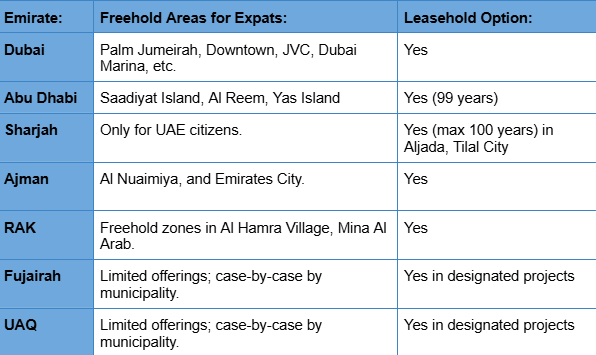
Areas Where Foreigners Can Own Property
Ownership rights for non-GCC expatriates are limited to approved zones, varying by emirate:
Joint Ownership Rules
- In UAE, properties can be jointly owned by two or more individuals or entities.
- Ownership shares must be clearly defined and registered.
- Inheritance, sale, or transfer of share is possible as per UAE inheritance laws (Shariah applies unless a registered will exists).
Ownership for Residents vs. Non-Residents
Here are the rules and regulations for property ownerships in the UAE.
1. UAE Residents (including expatriates with valid visas)
- They can buy freehold or leasehold in designated zones.
- They need to provide:
- Emirates ID,
- Valid UAE residence visa, and
- Proof of income or financing.
2. Non-Residents (international investors without a UAE visa)
- They can only buy property in freehold zones (especially in Dubai and Ajman).
- There is no requirement for UAE residency.
- They are typically required to:
- Have a valid passport,
- Pay in cash or via approved foreign bank, and
- Register the property with DLD or relevant authority.
Mortgage for Non-Residents:
It is available through certain UAE banks with higher down payment (usually 50%) and stricter eligibility.

Title Deed Registration Process
Once you buy a property in the UAE, you need to confirm official ownership by registering a title deed with the relevant land department according to the respective emirates (The details are mentioned in table: 1 above). This process confirms your legal ownership and is mandatory for completing the transaction.
Required Documents:
There are certain documents required to register your title deed:
- Signed Sales Purchase Agreement (SPA).
- Valid passport and visa copy (if applicable).
- Emirates ID (for residents).
- Payment receipt or proof of mortgage financing.
- No Objection Certificate (NOC) from developer (for secondary market).
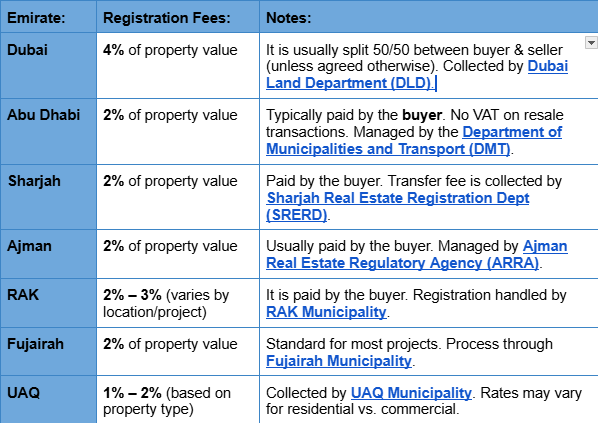
Registration Fees:
The registration fees breakdown is given below:
Title Deed vs. Oqood vs. SPA: What’s the Difference?
- Title Deed: It is the Official ownership certificate which is given by relevant land authority after handover/full payment.
- Oqood: It is the interim ownership record for off-plan properties given by relevant land authorities after initial payment. It protects your rights before the property is completed and the title deed is issued.
- SPA: A legally binding contract between the buyer and seller, typically issued by the developer or broker at the time of booking. It outlines the terms of the sale, payment schedule, and obligations of both parties.
Note: Oqood is not equal to full ownership. A title deed is the only official proof of ownership under UAE law.
RERA & DLD Compliance Guidelines
You should understand the roles and mandates of the Real Estate Regulatory Agency (RERA) and the Dubai Land Department (DLD) for Navigating property regulations in the UAE, especially in Dubai. These authorities are responsible for ensuring that real estate
activities are:
- Legal,
- Transparent, and
- Aligned with investor protection and consumer rights.
Let us provide you an in-depth guide to key compliance requirements, licensing laws, and the advertising standards set by these regulatory bodies.
Who is RERA?
RERA stands for Real Estate Regulatory Agency. It is the regulatory arm of the Dubai Land Department, established under Law No. 16 of 2007 to supervise Dubai's real estate sector.
What Are RERA’s Key Responsibilities?
RERA’s key responsibilities are:
- To regulate the relationship between landlords, tenants, developers, brokers, and property managers.
- It issues licenses to real estate professionals (brokers, property managers, valuers).
- Its job is to monitor compliance with real estate laws, including tenancy rules and project transparency.
- It is responsible to set rental caps and rental increase limits based on the Rental Index updated quarterly.
Note: In Dubai, Landlords cannot arbitrarily increase rent. Rent increase must follow RERA’s official Rental Increase Calculator (Dubai Law No. (26) of 2007, amended by Law No. (33) of 2008).
Who Is DLD?
DLD stands for Dubai Land Department. It is the government entity responsible for handling:
- Property transactions,
- Ownership transfers, and
- Investor protection policies in Dubai.
While its scope is Dubai-specific, many principles are in line with broader UAE practices.
Key DLD Compliance Areas:
Major compliance and regulatory areas DLD handle, are:
- Transfer of Ownership
DLD transfers service is responsible for:
- All your property transfers (sale, gift, inheritance) must be registered through the DLD.
- A title deed is issued upon successful registration.
- Registration requires submission of valid documents and payment of the 4% transfer fee (in Dubai).
- Verification of documents (e.g., title deed, NOC, identification)
- Collection of transfer fees and registration charges
- Issuance of a new Title Deed in the name of the new owner
- Ensuring compliance with all legal and regulatory requirements
- Updating records in the DLD’s official registry
- Broker and Developer Registration
You can register as a broker and developer via DLD broker and developer registration service.
- All real estate brokers, developers, and valuation firms must be licensed by RERA and registered in DLD's Trakheesi system.
- Developers are also required to be enrolled in the Project Registration System (Oqood) and must follow escrow account regulations (see below).
- Escrow Accounts for Off-Plan Projects
As per Law No. 8 of 2007 (Dubai Escrow Law). This protects buyers from fraud and project abandonment.
- All payments made for off-plan properties must be deposited into a developer’s escrow account, regulated by DLD.
- These accounts make sure that developer funds are only used for construction of the specific registered project.
Licensing & Advertising Rules
Real estate marketing and advertising in the UAE is strictly regulated, be it online and on billboards.
Rules for Advertising Real Estate Properties:
- Advertising Permits (Dubai - Trakheesi System)
- If you are a company or agent wishing to advertise a property, you should first:
- Be registered with DLD and RERA.
- Obtain a Trakheesi permit number for every ad.
- The permit ensures:
- Your ad is for a real, registered property.
- The agent has legal authority to advertise it.
Note: If you are publishing ads without a permit, it can lead to fines or license suspension.
- Licensing of Real Estate Professionals
- Agents, brokers, and property managers must:
- Hold a valid RERA license.
- They need to complete mandatory training through the Dubai Real Estate Institute (DREI).
- Renew licenses annually and maintain a clean professional record.
UAE-Wide Compliance Notes: While RERA and DLD regulations apply directly to Dubai, other emirates enforce similar compliance structures via their own authorities (you can see that in table 1 above).

Ejari Registration Process (Dubai-Specific)
The Ejari system is a cornerstone of Dubai's regulated rental market. It is managed by the Real Estate Regulatory Agency (RERA) under the Dubai Land Department (DLD), Ejari ensures transparency and legal enforceability of tenancy contracts between landlords and tenants.
While Ejari is specific to Dubai, other emirates have their own rental registration systems (see note below).
What is Ejari?
Ejari is an Arabic word which means “My Rent”. It is an online registration system that formally registers tenancy contracts with the Dubai Land Department. It was introduced under Law No. 26 of 2007 and strengthened through Law No. 33 of 2008.
Why is Ejari Important?
Ejari is important because:
- It makes tenancy agreements legally binding and enforceable in court.
- It protects the rights of both landlord and tenants.
- You need it for:
- Setting up your DEWA (Dubai Electricity & Water Authority) accounts.
- Visa renewals linked to housing.
- Filing disputes at the Rental Dispute Center (RDC).
- Applying for residency permits for family members.
Note: Without Ejari, your lease is not legally recognized, and you may be denied government services.
How to Register an Ejari Contract?
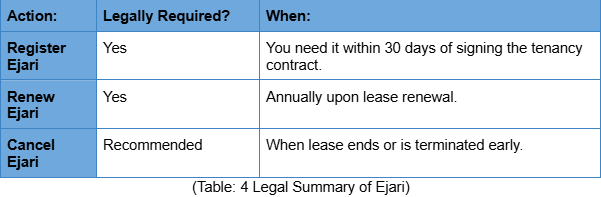
Ejari registration can be completed online or in person and must be renewed annually with every new lease or renewal.
Registration Methods:
- Online via Dubai REST App or DLD Website
- First download the Dubai REST mobile app or visit DLD’s Ejari portal.
- You can upload documents and complete the process digitally.
- It is suitable for individuals, landlords, and property managers.
- In-Person via Typing Centers
- You can visit an approved Ejari typing center across Dubai.
- Submit physical documents and pay the service fee.
Note: If you are unfamiliar with online systems, typing centers are ideal solutions for you.
Required Documents:
- Original tenancy contract signed by both parties.
- Tenant's Emirates ID (or passport & visa page for non-residents).
- Landlord's Emirates ID or trade license (if company-owned).
- Title deed of the rented property.
- Previous Ejari certificate (for renewals).
- DEWA Premises Number (optional but often required).
Fees:
- Standard Ejari registration: AED 155 (online or in typing center).
- Ejari renewal: AED 155.
- Ejari cancellation: Free or minimal fee depending on service provider.
Common Ejari Issues & Solutions
Ejari adds transparency in the system but some users still encounter common issues that can delay legal processes or dispute resolution.
Issue 1: Ejari Mismatch in Disputes
- Problem: Tenant files a complaint at RDC, but contract isn’t registered with Ejari.
- Solution: Always make sure that your contract is registered within 30 days of signing. You can use the Ejari verification tool for it.
Issue 2: Unauthorized Tenancy Registrations
- Problem: Some landlords or agents register Ejari without the tenant’s knowledge or for incorrect units.
- Solution: Tenants should request a copy of the Ejari certificate and verify that it matches the actual unit and lease terms. If you discover any falsification, disputes can be raised at RDC.
Ejari Renewal and Cancellation
- You should renew your Ejari annually with each lease renewal.
- You can use the Dubai REST app or return to a typing center with the new contract.
- If a lease is terminated early or not renewed, you can request Ejari cancellation (needed for DEWA disconnection or tenant visa changes).
Legal Summary:
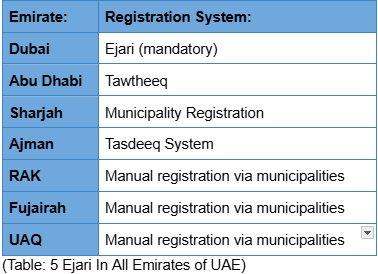
Ejari in Other Emirates
Ejari is exclusive to Dubai but other emirates have their own systems for rental contract registration:
Landlord and Tenant Rights & Obligations (UAE Real Estate Law)
It is very important to understand your rights and responsibilities as a landlord or tenant is essential for a fair and legally compliant rental relationship. The UAE's tenancy laws particularly Dubai’s Law No. 26 of 2007 and Law No. 33 of 2008 define these roles clearly, ensuring protection for both parties.
The content below mainly focuses on Dubai but the core principles apply across all emirates, with minor procedural differences. So, always refer to your local municipality or real estate authority for emirate-specific enforcement.
Key Legal Rights of Tenants
UAE tenants are granted important rights under property and civil law. In regulated emirates like Dubai, RERA ensures additional protections.
1. Right to a Habitable Living Space
Your landlords are legally obligated to provide you with a clean, safe, and livable residence that meets health and safety standards (Refer to: Article 15, Dubai Law No. 26 of 2007).
2. Right to Renew the Contract
Tenants have the right to renew their tenancy agreement unless the landlord has a valid legal reason (e.g., personal use or demolition). Landlords must give at least 90 days’ written notice before refusing renewal or changing terms. (Refer to: Article 14, Law No. 33 of 2008 Dubai)
3. Protection from Arbitrary Rent Increases
In Dubai, rent increases are regulated by the RERA Rental Index and can only occur if the current rent is below the market threshold. You can use the official RERA Rental Increase Calculator yourself to calculate it.
Key Legal Responsibilities of Tenants
Tenants must meet some key obligations defined by UAE tenancy laws and their lease agreement.
1. Timely Payment of Rent and Utilities
Tenants must pay the rent on the agreed date. Plus the tenants are typically responsible for utility bills (e.g., DEWA, gas, internet) unless stated otherwise in the contract.
2. No Subletting Without Permission
Tenants cannot sublease the property or assign the lease to others without written consent from the landlord. If you are violating this, it may result in legal eviction under Article 25, Law No. 33 of 2008 (Dubai)
3. Maintenance of Minor Repairs
Tenants are responsible for day-to-day maintenance of the property. It includes the minor repairs as well, such as replacing light bulbs, AC filter cleaning, and keeping the property clean. Whereas landlords will handle major structural repairs.
Rights of Landlords
The UAE legal system also provides protections for landlords. It makes sure that their property is maintained and fairly used.
1. Right to Receive Rent On Time
Landlords are entitled to receive timely rental payments. Non-payment after 30 days of written notice may lead to legal eviction [Article 25(1), Law No. 33 of 2008 (Dubai].
2. Right to Evict Under Legal Grounds
Landlords can evict tenants according to Eviction Rules. It can happen due to:
- Breach of contract,
- Non-payment,
- Illegal use of property, or
- If they need the property for personal use or sale.
But only with proper notice:
- 90-day notice for renewal changes.
- 12-month notice for eviction due to sale/personal use (served via notary or registered mail).
3. Right to Inspect the Property (with Notice)
Landlords may inspect their property with reasonable prior notice, typically 24-48 hours, unless the lease specifies otherwise.
Responsibilities of Landlords
Landlords have some legal duties that directly affect tenant welfare and contractual obligations.
1. Provide a Habitable Space
Landlords must ensure the unit is:
- Structurally sound.
- Safe to occupy.
- Equipped with basic utilities (water, electricity, sanitation).
2. Handle Major Repairs
Landlords are responsible for major maintenance and structural repairs, such as:
- Water leaks.
- Electrical failures.
- AC unit malfunctions (not cleaning).
In case of failure to carry out timely repairs, it can be counted as a breach of contract.
3. Ejari or Local Contract Registration
In Dubai, landlords must ensure the lease is registered with Ejari. It legalizes the agreement and links it to government systems.
While the other emirates (like Abu Dhabi, Sharjah, Ajman) require registration through Tawtheeq, Municipality, or Tasdeeq (you can check it in Table:5 above).
Tenants cannot connect utilities or sponsor families without a registered lease.
Emirates-Wide Note:
- While specific laws like Law No. 33 of 2008 apply to Dubai, all emirates follow similar civil and rental practices, often based on the UAE Civil Code (Federal Law No. 5 of 1985) and municipal bylaws.
- Rental disputes and responsibilities are enforceable via the local courts or rent committees in each emirate.
Guaranteed Results with Trusted Legal Experts
- Skilled and experienced lawyers
- Fast, reliable service
- Comprehensive, client-focused solutions

Get Free Consultation!
We are ready to answer right now! Sign up for a free consultation.
I consent to the processing of personal data and agree with the user agreement and privacy policy